

Choosing between tinned food and kibble can feel like a never-ending debate, especially when every label claims to be the healthiest. Vets tend to focus less on the format and more on hydration, calories, and whether the diet suits your cat’s life stage and health needs. Here’s a practical guide to help you choose what works best for your household.
What vets actually look for in a cat’s diet
When vets weigh up different feeding formats, the first question is rarely “which is best?” It’s “does this cat get enough water, the right calories, and complete nutrition every day?” A food can come in a tin, tray, pouch, or bag and still be a poor fit if it’s overfed, incomplete, or ignored by a fussy eater.
In practice, vets commonly focus on:
- Complete and balanced nutrition for your cat’s life stage (kitten, adult, senior).
- Hydration support, especially for cats that drink little.
- Body condition: steady, healthy weight and muscle tone.
- Digestive comfort: normal stools, minimal vomiting, good appetite.
- Dental and urinary considerations based on your cat’s history.
Look for wording such as “complete” or “complete and balanced” on the label. Many manufacturers formulate to recognised nutrient profiles (for example, AAFCO or FEDIAF standards), which is a useful safeguard that the food contains essential nutrients in appropriate amounts. “Complementary” foods are typically designed to be fed alongside other foods, not as the sole diet.
One more thing vets care about: whether the feeding routine is realistic for you. The best choice is the one you can measure, store safely, and serve consistently.
Wet food: key pros, cons, and who it suits
Wet food is often suggested for cats that need help with water intake, because it naturally contains much more moisture than dry diets. Many cats also find it more aromatic and palatable, which can help if appetite is variable.
Pros vets like:
- Hydration boost: useful for cats that rarely visit the water bowl.
- Portion flexibility: easier to serve small, measured amounts.
- Palatability: can support appetite in picky cats.
Cons to manage:
- Cost per calorie is often higher than dry food.
- Shorter shelf life once opened: needs prompt refrigeration and hygienic bowls.
- Calories can add up if multiple sachets are offered without measuring.
Urinary-health note: extra moisture can support hydration, which may be helpful for some cats, but it isn’t a treatment for urinary disease. If your cat has straining, blood in urine, frequent trips to the tray, or a history of urinary issues, seek veterinary advice promptly. Prescription urinary diets (where recommended) should be chosen and used under vet direction.
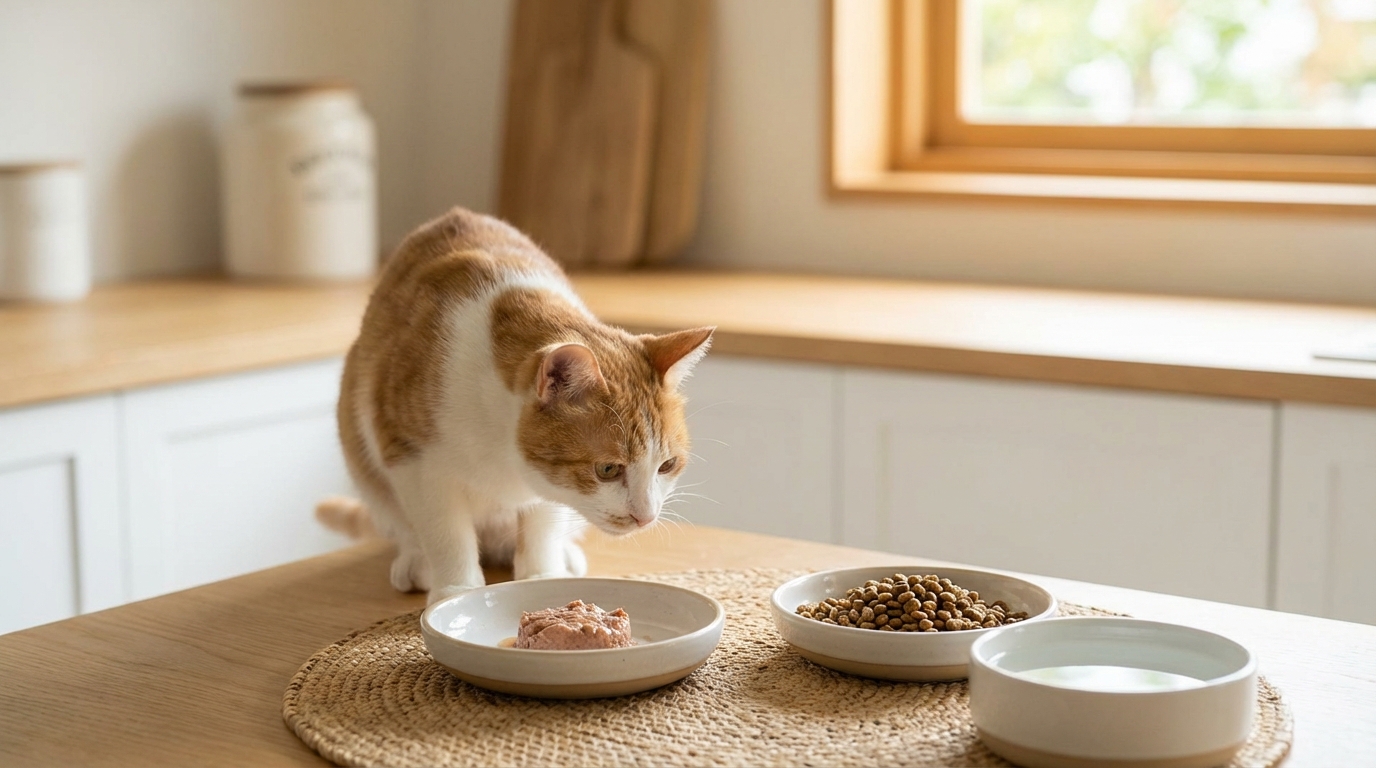
Dry food: key pros, cons, and who it suits
Dry food is popular because it’s convenient, easy to store, and straightforward to measure. Its biggest advantage is often consistency: the same scoop (ideally, the same weighed portion), the same calories, day after day.
Pros vets like:
- Convenience: simpler for busy households and multi-cat homes.
- Budget-friendly for many families.
- Can work well with feeding toys to slow fast eaters and add enrichment.
Cons to consider:
- Lower moisture: may not suit cats that don’t drink enough.
- Overfeeding is easy: “just a little extra” adds up quickly.
- Dental myths: kibble alone rarely “cleans teeth” in a meaningful way.
If you choose a mainly dry diet, make hydration part of the plan. Offer multiple water sources, wash bowls frequently, and consider a water fountain if your cat prefers moving water.
Quick tip: Measure food by weight where possible (kitchen scales beat guesswork). Small daily overfeeds can lead to slow, steady weight gain that’s easy to miss.
Feeding guides, calorie density, and avoiding overfeeding
Feeding guides are a starting point, not a rule. They’re usually written for an “average” cat, but real cats vary in activity, age, neuter status, and body condition. What matters most is the calorie density of the food and the total calories per day across all meals, treats, and extras.
Here’s how to use the label information more accurately:
- Find calories on the pack: wet food may list kcal per pouch/tin or kcal per 100g; dry food may list kcal per kg or per 100g.
- Convert to what you actually feed: if a wet food is listed as kcal per 100g and you serve 85g, multiply by 0.85 to estimate calories for that portion.
- Check the scoop isn’t misleading: different kibbles have different densities; a “cup” can vary a lot in grams between foods.
If you’re feeding a mixed routine, use a simple budgeting approach:
- Step 1: choose your cat’s daily calorie target (your vet can help, especially if weight needs adjusting).
- Step 2: decide how many calories you want to come from wet meals versus dry meals.
- Step 3: calculate portions from the kcal information on each pack so the combined total stays on target.
This prevents the most common mixed-feeding mistake: giving “a full wet portion” plus “the usual bowl of kibble”, which can unintentionally turn into two full diets.
Two simple portioning examples (for illustration only):
- Example A (mostly wet): If your cat’s daily target is 220 kcal, and one wet pouch provides 85 kcal, you might feed 2 pouches (= 170 kcal) and “budget” the remaining 50 kcal for dry food. If the dry food is 400 kcal per 100g, then 50 kcal is 12.5g (because 400 kcal/100g = 4 kcal/g; 50 ÷ 4 = 12.5g).
- Example B (more balanced): If the daily target is 250 kcal, you could aim for half from wet and half from dry. If one wet pouch is 90 kcal, then 1 pouch leaves 160 kcal for dry food. If the dry food is 380 kcal per 100g (3.8 kcal/g), then 160 kcal is about 42g (160 ÷ 3.8 ≈ 42).
These numbers are examples to show the maths. Always use the calories on your food’s label, and check progress using body condition and weigh-ins rather than sticking rigidly to a printed guide.
Mixing wet and dry: a vet-friendly middle ground
For many cats, the ideal approach isn’t strictly one or the other. A blended routine can combine the moisture and aroma of wet food with the convenience of dry.
A simple plan is wet food at set meal times and a measured portion of dry food for enrichment (for example, in a puzzle feeder). The important part is that the total daily calories stay appropriate; otherwise, combining formats can quietly increase intake.
Multi-cat households: mixed feeding can get tricky when one cat steals another’s food. If you’re seeing bullying or bowl-hopping, try feeding cats separately, picking up bowls after set meal times, and using timed feeders or microchip-activated feeders so each cat gets their own measured portion.
When transitioning, change gradually over 7–10 days to reduce tummy upsets. Watch appetite, stool quality, and water intake during the swap—those day-to-day signs are often more useful than getting stuck in ingredient debates.
How to choose: a simple shopping checklist
If you’re still deciding, use this checklist to choose confidently and keep your cat thriving.
- Choose “complete” rather than “complementary” as the main diet, so your cat gets all required nutrients.
- Match life stage: kittens need higher energy and different nutrient levels than adults and seniors.
- Prioritise measurable feeding: pick a format you can portion accurately every day.
- Plan for hydration: if your cat drinks little, build in wet meals and make water access easy.
- Support healthy weight: reassess body condition regularly and adjust portions based on results, not habit.
- Don’t rely on kibble for dental care: consider a proper oral-care routine if teeth and gums are a concern.
- Keep changes gradual: sudden swaps can lead to food refusal or digestive upset.
- Look at your cat, not just the label: glossy coat, good energy, steady weight, and normal stools are your best indicators.
Also consider practicality: storage space, fridge capacity for opened tins, and whether timed feeding or puzzle feeding fits your routine. The “right” option is the one your cat eats reliably and that you can maintain long-term.
Frequently Asked Questions
Is wet food always better than dry food for cats?
Not always. Wet food can be excellent for hydration and palatability, but a well-formulated dry diet can also be complete and balanced. The better option depends on your cat’s drinking habits, weight, and how reliably you can portion meals.
Can I feed only dry food if my cat won’t eat wet?
Yes, many cats do well on dry food alone as long as it’s complete and you manage portions carefully. Encourage water intake with clean bowls, multiple water stations, or a fountain, and monitor weight and litter tray habits.
Does dry food clean a cat’s teeth?
Dry food may provide some mild abrasion, but it generally doesn’t replace proper dental care. If dental health is a concern, consider tooth brushing, dental-focused products made for cats, and regular checks.
Is wet food better for senior cats?
It can be, especially if a senior cat has a reduced appetite, dental sensitivity, or benefits from extra moisture in the diet. However, plenty of older cats do well on dry food too. The priority is a complete senior-appropriate diet, comfortable eating, and maintaining healthy body condition and muscle.
How long can wet food be left out?
As a conservative guideline, wet food is best picked up after about 1–2 hours at typical indoor room temperature. If your home is especially warm, if flies are an issue, or if your cat tends to “graze” slowly, shorten that window and offer smaller, more frequent portions instead. Always discard leftovers that have been sitting out, and wash bowls with hot, soapy water between meals.
If you’re choosing food for a cat with ongoing health issues, recurring urinary signs, or sudden appetite changes, speak with your vet for tailored guidance.